
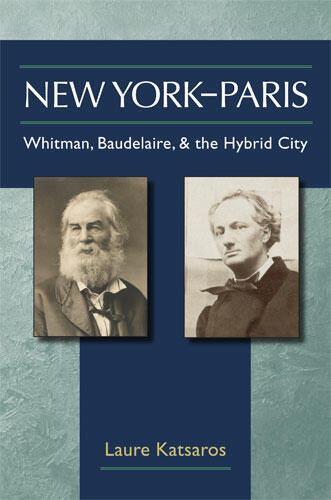
A comparison of the mid-19th-century city in the poetry of Walt Whitman and Charles Baudelaire and their responses to the inescapable push of modernization
Description
As New York and Paris began to modernize, new modes of entertainment, such as panoramas, dioramas, and photography, seemed poised to take the place of the more complex forms of literary expression. Dioramas and photography were invented in Paris but soon spread to America, forming part of an increasingly universal idiom of the spectacle. This brave new world of technologically advanced but crudely mimetic spectacles haunts both Whitman's vision of New York and Baudelaire's view of Paris. In New York-Paris, Katsaros explores the images of the mid-nineteenth-century city in the poetry of both Whitman and Baudelaire and seeks to demonstrate that, by projecting an image of the other's city onto his own, each poet tried to resist the apparently irresistible forward momentum of modernity rather than create a paradigmatically happy mixture of "high" and "low" culture.
Laure Katsaros is Associate Professor of French and European Studies at Amherst College.
Reviews
"The book is accessible to readers at large but will be particularly useful for students of English, French, and comparative literature."
- D.D. Kummings
—D.D. Kummings, Choice
"New York-Paris offers a compelling and well-researched new line of inquiry by connecting Baudelaire and Whitman to a plethora of technological modes of art."
- Karen F. Quandt, University of Delaware
—Nineteenth-Century French Studies